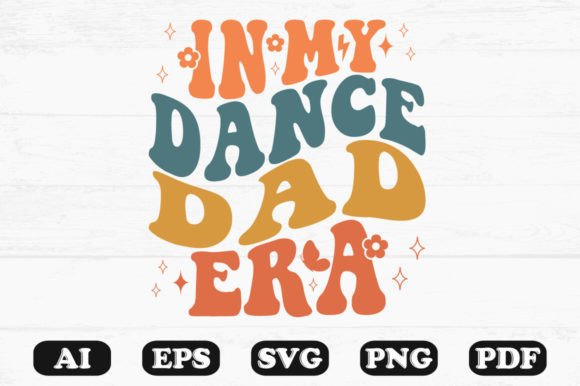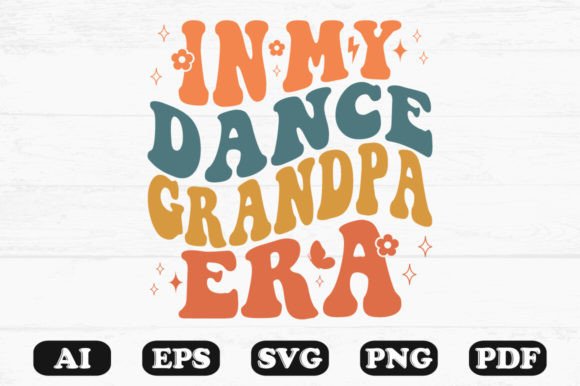
In My Dance Grandpa Era Retro Wavy SVG
Let’s be real: not every retro typography SVG translates cleanly to embroidery. I tested In My Dance Grandpa Era Retro Wavy SVG on a custom embroidered canvas tote bag for a local dance studio’s grandparent appreciation day — and that’s where its personality truly revealed itself.
A Design That Smiles Before It Stitches
At first glance, In My Dance Grandpa Era Retro Wavy SVG feels warm, playful, and gently nostalgic — less “vintage costume party” and more “your grandpa’s record sleeve doodled on a napkin.” The wavy baseline gives it rhythm without chaos; the letterforms are chunky enough to hold up in satin stitch but retain subtle quirks (like the softened terminals on the “G” and “R”) that keep it from feeling generic. It’s not a bold statement piece — it’s a conversation starter. That makes it ideal for handmade products where charm matters more than impact: baby onesies, aprons for dance moms, pillow covers for nursery decor, or even embroidered tea towels gifted at retirement parties.
Where It Shines in Real Embroidery Projects
This isn’t a one-size-fits-all machine embroidery design. Its strength lies in context. On a medium-weight cotton sweatshirt? Excellent — the curves translate smoothly into fill and satin stitches, and the spacing between letters avoids thread nesting. As a small embroidered patch on a denim jacket? Works well at 3.5" wide with proper tear-away stabilizer. For a personalized gift like a toddler’s backpack or a holiday mug cozy? The friendly tone lands perfectly — customers respond to sincerity, not flash.
I also used it as part of a boutique collection for a craft fair: paired with simple floral motifs and stitched onto unbleached linen pillow covers. The retro wavy style contrasted beautifully with the natural texture, and buyers consistently remarked how “uniquely personal” it felt — even though it’s a digital embroidery file. That’s the quiet power of thoughtful typography: it adds handmade character without requiring complex digitizing.
Use With Care — Not Every Surface Is Friendly
Don’t force In My Dance Grandpa Era Retro Wavy SVG where it doesn’t belong. On thin or stretchy fabric (like lightweight jersey tees), the wavy baseline can exaggerate puckering if stabilizer isn’t layered thoughtfully. On dark fabric, avoid light pastel thread unless you’re using a high-contrast underlay — those soft curves need definition. And skip it entirely for curved surfaces like structured caps unless you’ve tested the distortion on your specific cap frame and hoop setup.
The lettering is legible down to about 2.75", but below that, the inner counters (like the center of the “a” or “e”) risk filling in or losing clarity — especially with dense fill stitch. If you're planning baby embroidery or tiny embroidered patches, test stitch on scrap first. Also, avoid layering this over heavy applique or textured embroidery — the wavy flow gets visually muddled when competing with visual weight.
What It Adds to Your Craft Business — and What It Doesn’t
As an Etsy seller and small shop product developer, I look for design assets that support brand consistency *and* customer trust. In My Dance Grandpa Era Retro Wavy SVG delivers both — when used intentionally. It signals warmth, intergenerational joy, and lighthearted craftsmanship. That builds recognition across listings: whether it’s on a printable mockup for your digital shop or stitched onto a limited-run tote, it reads as part of a cohesive story.
But let’s be clear — it won’t replace a custom-drawn monogram or serve as primary branding for a high-end apparel line. Its value is in accessibility and emotional resonance, not exclusivity. For craft business owners selling personalized gifts or holiday embroidery, it’s a reliable, repeatable asset that customers understand instantly — no explanation needed.
Practical Notes From the Hoop
- Always test first: Run In My Dance Grandpa Era Retro Wavy SVG on scrap fabric matching your final project’s weight and stretch.
- Check thread color contrast: Try black, navy, and rust thread on both light and dark backgrounds — the wavy shape benefits from strong tonal separation.
- Review stitch density: If your embroidery software allows, inspect the fill areas — avoid overly dense regions that could stiffen delicate fabrics like baby clothes.
- Confirm hoop compatibility: This design works best in standard 4x4 or larger hoops. Don’t squeeze it into a 3x3 without checking corner clearance.
- Inspect small details: Zoom in on the tightest curves — ensure no tiny gaps or overlapping vectors that might cause jump stitches.
- Test black-and-white mockups: Since it’s often used in craft business listings, verify readability in grayscale previews — customers browse fast.
- Match stabilizer to fabric: Tear-away for stable cottons; cut-away for knits or anything that will be washed repeatedly.
- Verify licensing: As a Graphics product sold for Crafts use, confirm whether commercial embroidery rights are included before selling finished embroidered items or bundling it into digital product kits.
Bottom line? In My Dance Grandpa Era Retro Wavy SVG isn’t flashy — and that’s why it works. It fits naturally into real-life embroidery projects where authenticity matters more than perfection: a grandmother’s birthday sweatshirt, a dance studio’s volunteer thank-you tote, a handmade kitchen towel for a new home. It’s the kind of design that makes people smile, then pause, then say, “I want one of those.” And in craft business, that’s the best endorsement you’ll get.