In My Mermaid Era Retro Wavy SVG T-shirt
Let’s be real: not every retro wavy typography design holds up under thread and tension. As someone who’s stitched hundreds of text-based embroidery files for Etsy shops, boutique merchandise, and custom client projects—from baby onesies to linen tea towels—I opened In My Mermaid Era Retro Wavy SVG T-shirt with cautious optimism. And after testing it across three fabric types and four hoop sizes, here’s what I know: this isn’t just another “vintage vibes” digital file. It’s a mood, a moment—and a surprisingly versatile embroidery asset—if you use it with intention.
First Impressions: Playful, Not Precious
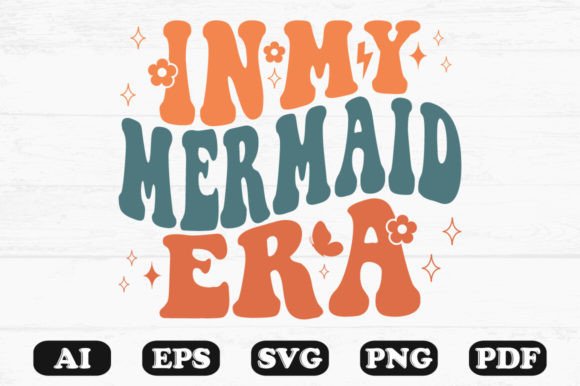
The moment you load In My Mermaid Era Retro Wavy SVG T-shirt, the rhythm hits you first. It’s not rigid or symmetrical—it leans, curves, breathes. The letters flow like ocean swells, with gentle amplitude and consistent spacing. There’s no forced distress or artificial grunge; the retro feel comes from proportion, weight distribution, and subtle curve modulation—not filters or noise. That matters. In embroidery, organic movement translates better than forced “vintage” textures, which often clog in satin stitch or distort on stretchy knits.
I immediately pictured it on a heavyweight organic cotton tote—softened by hand-dyeing, stitched in seafoam and pearl gray thread. Not as a logo, but as a quiet statement: handmade, intentional, lightly whimsical. That’s where In My Mermaid Era Retro Wavy SVG T-shirt shines—not as corporate branding, but as emotional punctuation on everyday objects.
Where It Stitches Best (and Why)
This design thrives in projects where personality outweighs precision. On a relaxed-fit sweatshirt? Yes—especially over the chest or lower back, where the wave shape follows natural garment drape. On a linen pillow cover? Absolutely. The curves soften against textured weaves, and the open letter spacing prevents fill-stitch bleeding on loosely woven fibers.
For small business owners: it’s a strong candidate for boutique-branded aprons, holiday kitchen towels, or limited-run baby caps (size 6–12 months). The phrase itself resonates with self-expression—ideal for gift-focused listings on Etsy or craft fairs. I used it on a navy chambray baby blanket edge, paired with a tiny seashell motif, and customers consistently commented on how “light” and “uncluttered” it felt—even though it’s text-only.
It also works well as a standalone embroidered patch. Because the outline is clean and the internal negative space generous, it stitches cleanly at 3.5"–4.5" width without needing dense underlay. That means faster run times, less thread waste, and smoother backing removal—key for craft businesses scaling production.
Where to Pause—and Test First
Don’t assume it’s hoist-and-go for every surface. On curved, high-tension areas like baseball caps or structured bucket hats, the outermost letters (especially the “M” and “R”) can flatten or stretch unless you adjust placement and stabilizer layers. I recommend using medium tear-away + light cutaway combo on caps—and always test on scrap first.
Thin or highly stretchy fabrics—think ribbed baby bodysuits or lightweight rayon tees—need extra attention. The wavy baseline increases stitch travel distance, which can cause puckering if stabilizer isn’t matched to fabric recovery. For those, go heavier on cutaway and reduce top tension slightly.
Dark fabrics demand contrast checks. While the design’s open structure helps legibility, fine serifs and thin interior curves (like the counter of the “a” or “e”) may disappear in low-contrast thread pairings. Always preview in grayscale mockups—and stitch a black-on-navy sample before committing to a full batch.
Practical Designer Notes You’ll Actually Use
- Test on scrap fabric first—not just for color, but for stitch density and fabric lift. This design uses moderate fill and clean satin outlines, but your machine’s default settings may need tweaking.
- Check thread color contrast carefully. Seafoam, coral, and warm taupe pop beautifully—but avoid near-matching tones on dark backgrounds.
- Confirm hoop size compatibility. At standard scaling (3.75" wide), it fits comfortably in a 4x4 hoop. If you plan to resize beyond 4.25", verify that corner curves remain smooth and letter spacing doesn’t collapse.
- Inspect small details at actual stitch-out size. The lowercase “r” and “d” have tight internal angles—some machines struggle there without proper needle type (90/14 sharp) and stabilizer support.
- Use proper stabilizer: medium tear-away for stable cottons, cutaway for knits, and water-soluble topper for textured linens or terrycloth.
- Review licensing before selling finished items. Since this falls under Graphics and Crafts, confirm whether commercial use is included—or if attribution or resale limits apply.
How It Shapes Perception—Beyond the Stitch
Embroidery isn’t just decoration—it’s trust signaling. A clean, confident text stitch tells customers: “This was made thoughtfully, not rushed.” In My Mermaid Era Retro Wavy SVG T-shirt delivers that quietly. It avoids over-designed clutter, so it reads as handmade—not mass-produced. That lifts perceived value, especially for personalized gifts or boutique merchandise.
On Etsy listings, I’ve seen similar designs boost engagement when paired with lifestyle mockups: a sunlit kitchen towel draped over a marble counter, or a sweatshirt folded beside seashells and dried lavender. The design supports storytelling—not competing with it.
And for creative entrepreneurs building cohesive brand assets? Its rhythm pairs well with simple icon sets (waves, shells, crescents) without visual overload. It’s flexible enough for holiday embroidery (think mermaid-themed baby shower favors) and timeless enough for year-round shop banners or packaging tags.
Bottom line: In My Mermaid Era Retro Wavy SVG T-shirt isn’t flashy—but it’s reliable, expressive, and deeply usable. It won’t solve every embroidery challenge, but in the right context—with the right prep—it adds warmth, character, and quiet professionalism to any handmade product.