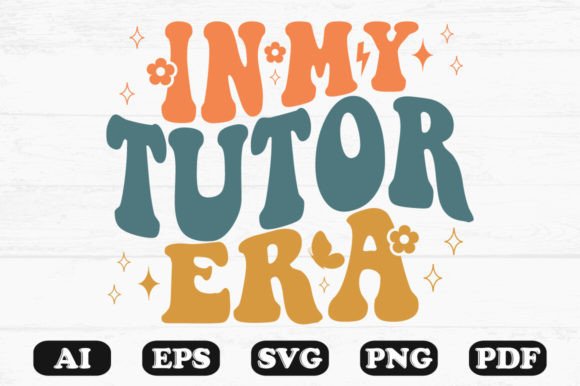
In My Tutor Era Retro Wavy SVG
As a designer who’s stitched over 300 custom embroidery projects—from boutique baby onesies to Etsy shop merch—I opened In My Tutor Era Retro Wavy SVG expecting charm, not complexity. What I found was a tight, confident typographic gesture: soft undulating curves, balanced negative space, and that unmistakable late-’80s/early-’90s tutor-era warmth—think chalkboards, hand-drawn lesson plans, and quiet classroom pride. It’s not loud. It’s not ironic. It’s gently nostalgic, with just enough visual rhythm to hold attention without overwhelming the fabric.
First Stitch, First Impression: Does It Feel Handmade—or Just Digital?
I tested In My Tutor Era Retro Wavy SVG on a medium-weight cotton twill tote bag—my go-to for client samples. Right away, the wavy baseline translated beautifully into satin stitch flow. No jagged peaks, no collapsed curves. The letterforms breathe; the “I” and “y” have subtle weight shifts that read as intentional, not accidental. That matters. When you’re selling a handmade product, customers don’t just buy text—they buy *feeling*. This design delivers sincerity, not sarcasm. It says “I showed up,” not “I’m pretending.” For small shop owners or Etsy sellers offering personalized gifts, that tone builds trust faster than any description.
Where It Shines—and Where It Asks for Care
In My Tutor Era Retro Wavy SVG excels in mid-to-large-scale applications: sweatshirt chest placements, pillow covers (especially linen or canvas), aprons for educators or makers, and kitchen towels where texture enhances the retro vibe. On a structured cotton poplin shirt, it held crispness without stiffness. As a machine embroidery design, it avoids dense fill-stitch traps—most of the shape relies on clean satin and running stitch outlines, which means lower stitch density, less thread buildup, and better drape.
But here’s where practicality kicks in: avoid using In My Tutor Era Retro Wavy SVG on highly textured fabrics like bouclé or thick terry cloth without extra stabilizer testing. The gentle waves can blur if the fabric surface fights the stitch path. Also, skip it on ultra-thin fabrics (like lightweight rayon challis) unless you’re backing with tear-away + cutaway combo—those delicate curves need support to stay legible after washing.
For baby embroidery? Yes—but only on stable items like bibs or quilt blocks, never on stretchy knit onesies without significant digitizing tweaks. The design isn’t built for compression distortion. And caps? Not ideal. The curve of a cap bill fights the natural arc of the wave—it’ll pull and flatten unless resized and re-digitized specifically for curved surfaces.
Real Project Moment: A Teacher Appreciation Bundle
Last month, I prepped a small-batch teacher appreciation set: embroidered cotton tea towels, linen patch sets, and matching canvas pencil pouches. I used In My Tutor Era Retro Wavy SVG across all three—but adjusted execution each time. On the tea towel, I kept it full-size (3.5" wide) with high-contrast navy thread on off-white fabric—clear, warm, instantly readable. For the patch set, I shrunk it to 2.25", added a clean satin border, and fused it to twill. On the pencil pouch, I placed it low on the front panel, letting the wave echo the pouch’s zipper curve. Customers didn’t just recognize the phrase—they smiled. That’s the difference between a generic quote SVG and a considered embroidery file.
What This Design Adds to Your Craft Business
- Brand consistency: Its restrained palette-friendly styling works across apparel, home goods, and stationery mockups—ideal for cohesive Etsy listings or boutique branding.
- Giftability: It reads as heartfelt, not trendy—perfect for graduation, retirement, or end-of-year gifts where sentiment outweighs flash.
- Commercial safety: As a Typography SVG, it avoids copyright landmines (no logos, no branded fonts), making it safer for resale as part of your finished product—if your license permits commercial use.
- Printable mockup readiness: The clean lines and open counters translate flawlessly to digital previews, helping buyers visualize before purchase.
Embroidery Designer Notes You Can’t Skip
Before stitching In My Tutor Era Retro Wavy SVG on your next project, do these five things:
- Test it on scrap fabric *exactly* like your final material—including wash-and-dry cycle if applicable.
- Check thread color contrast: this design lives or dies by readability. Try it in black, charcoal, and deep olive on light backgrounds—and cream or pale yellow on darks.
- Review stitch density in your embroidery software. If you see overlapping satin columns or tiny isolated stitches in the “r” or “g”, adjust underlay or reduce scale slightly.
- Confirm hoop size compatibility. At full width (~4"), it fits standard 5x7 hoops—but verify clearance for your machine’s throat space, especially on layered garments like hoodies.
- Inspect small details at 200% zoom: the tail of the “y”, the curve of the “e”, and spacing between words should feel even—not rushed or cramped.
Also—don’t assume licensing. Since this is listed as a Graphics product in the Crafts category, double-check whether the bundle includes commercial use rights *for finished embroidered goods*, not just digital resale. Many SVG sellers restrict physical product sales unless upgraded. When in doubt, contact the creator before listing on Etsy or filling wholesale orders.
Final Thought: It’s Not Just Text—It’s a Vibe You Can Stitch
In My Tutor Era Retro Wavy SVG won’t replace your workhorse monogram or bold logo files—but it fills a quiet, valuable niche: the thoughtful, human-centered embroidery project. It’s the kind of design that makes a customer pause mid-scroll, click “add to cart,” and then tag a friend who *gets it*. For educators, lifelong learners, craft fair shoppers, or anyone who values understated authenticity, it lands with warmth and precision. Use it intentionally, test it thoroughly, and let its gentle wave carry your craftsmanship forward—not as background noise, but as quiet confidence, stitched.